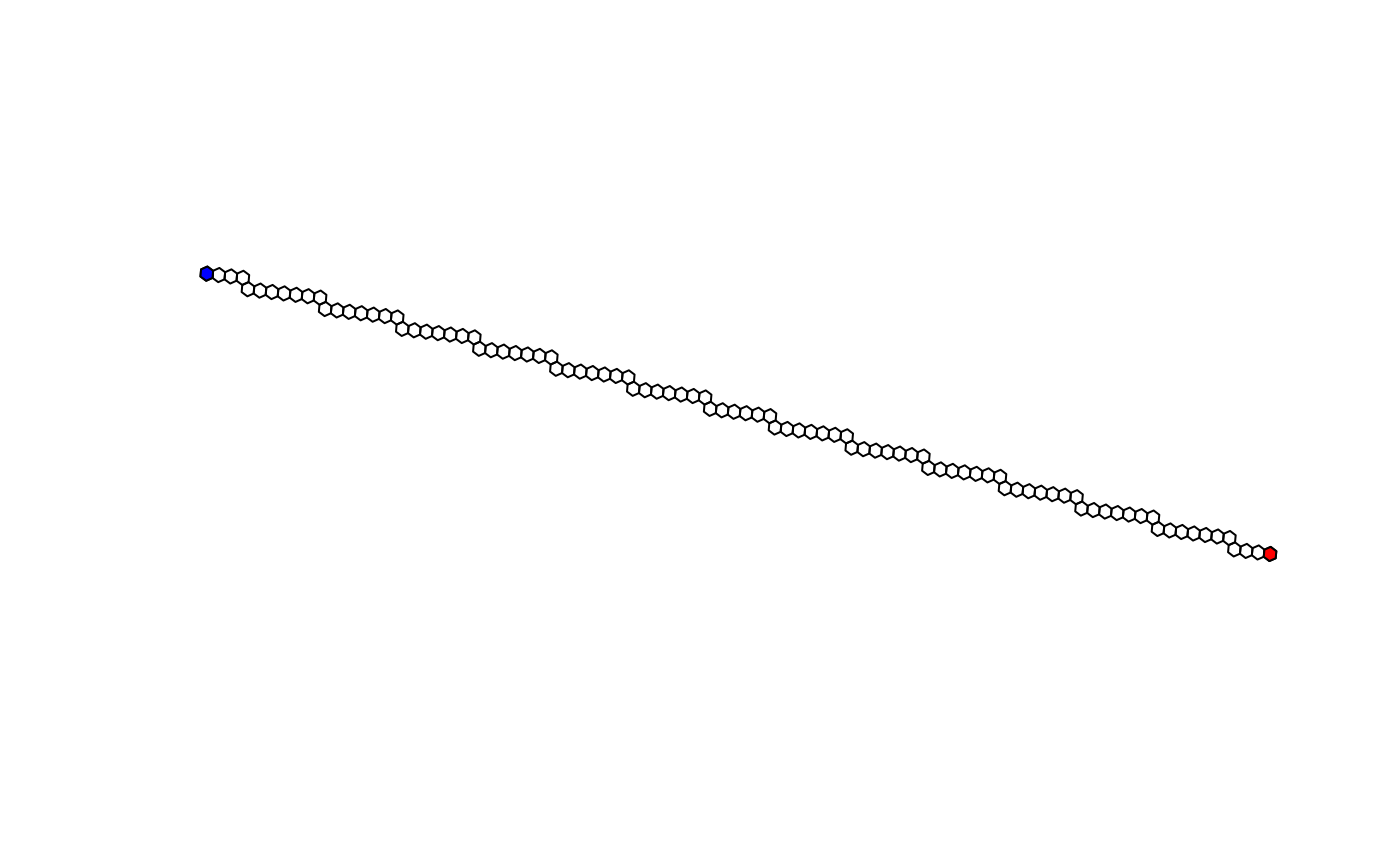
Given a starting H3 cell and a destination H3 cell, returns a minimal-length contiguous path of cells between them (inclusive).
Usage
ddbh3_grid_path_cells(
  x,
  h3start = "h3string",
  h3end,
  new_column = "h3path",
  nested = FALSE,
  conn = NULL,
  name = NULL,
  mode = NULL,
  overwrite = FALSE,
  quiet = FALSE
)
Arguments
- x
Input data. One of:
duckspatial_dfA lazy spatial data frame via dbplyr.
sfA spatial data frame.
tbl_lazyA lazy data frame from dbplyr.
data.frameA standard R data frame.
- character string
A table or view name in
conn.- character vector
A vector of values to operate on in vectorized mode (requires
conn = NULL).
- h3start
The name of a column in
xcontaining the H3 strings or H3 unsigned 64-bit integers (UBIGINT). The path starts on this cell- h3end
The name of a column in
xcontaining the H3 strings or H3 unsigned 64-bit integers (UBIGINT). It's the destination cell of the path- new_column
Character. Name of the new column to be created. Defaults to
"h3path".- nested
Logical. If
TRUE, children are returned as a nested list column (one row per parent cell). IfFALSE(default), the result is unnested so each child cell occupies its own row.- conn
A connection object to a DuckDB database. If
NULL, the function runs on a temporary DuckDB database.- name
A character string of length one specifying the name of the table, or a character string of length two specifying the schema and table names. If
NULL(the default), the function returns the result as ansfobject- mode
Character. Controls the return type. Options:
"duckspatial"(default): Lazy spatial data frame backed by dbplyr/DuckDB"sf": Eagerly collected sf object (uses memory)
Can be set globally via
ddbs_options(mode = "...")or per-function via this argument. Per-function overrides global setting.- overwrite
Boolean. whether to overwrite the existing table if it exists. Defaults to
FALSE. This argument is ignored whennameisNULL.- quiet
A logical value. If
TRUE, suppresses any informational messages. Defaults toFALSE.
Value
One of the following, depending on the inputs:
tbl_lazyIf
xis not spatial.duckspatial_dfIf
xis spatial (e.g. ansforduckspatial_dfobject).TRUE(invisibly)If
nameis provided, a table is created in the connection andTRUEis returned invisibly.- vector
If
xis a character vector andconn = NULL, the function operates in vectorized mode, returning a vector of the same length asx.
Examples
## Load packages
library(duckh3)
library(duckspatial)
library(sf)
ddbh3_default_conn()

## Create a data frame with the start and end of the path
h3_tbl <- data.frame(
  h3start = "883923059bfffff",
  h3end   = "883923d04dfffff"
)

## Get the number of cells distance between them
h3path_tbl <- ddbh3_grid_path_cells(
  h3_tbl,
  h3start = "h3start",
  h3end = "h3end"
)

## Convert path to spatial
h3path_sf <- ddbh3_h3_to_spatial(h3path_tbl, "h3path") |>
  ddbs_collect()

## Convert start and end to spatial
start_sf <- ddbh3_h3_to_spatial(h3_tbl, "h3start") |>
  ddbs_collect()

end_sf <- ddbh3_h3_to_spatial(h3_tbl, "h3end") |>
  ddbs_collect()

## Visualize the path
plot(h3path_sf$geometry)
plot(start_sf, add = TRUE, col = "red")
#> Warning: ignoring all but the first attribute
plot(end_sf, add = TRUE, col = "blue")
#> Warning: ignoring all but the first attribute